
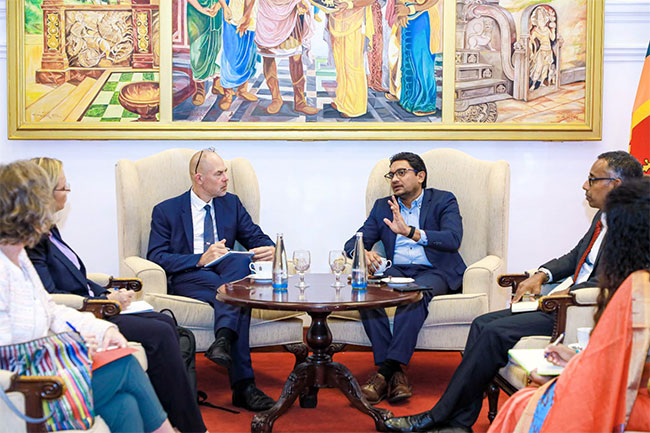
In a major move to boost industrial and economic cooperation between Sri Lanka and the European Union (EU), a special high-level discussion was held on October 15, chaired by Deputy Minister of Industry and Entrepreneurship Development, Chathuranga Abeysinghe. The meeting focused on leveraging the EU’s multi-billion-euro ‘Global Gateway’ strategy to drive fresh investments into Sri Lanka’s expanding market.
The EU delegation was led by Pēteris Ustubs, Director for Asia, Central Asia, and the Pacific at the European Commission’s Directorate-General for International Partnerships (DG INTPA). The discussion was also joined by Galia Agiševa, Deputy Head of the EU Delegation in Colombo, and Virginie Lafleur-Tighe, Head of Cooperation.
The European Union’s ‘Global Gateway’ strategy aims to mobilize nearly €300 billion in global development investments across key growth sectors, including digital technology, climate and energy transition, transport infrastructure, health, education, and research. Highlighting the potential benefits for local industries, Deputy Minister Abeysinghe emphasized the need to align Sri Lanka’s small and medium-sized enterprises (SMEs) with international trade standards, enabling local entrepreneurs to seamlessly access global export markets. To foster a dynamic startup ecosystem, the Deputy Minister sought EU assistance to establish startup incubators—dedicated centers designed to provide emerging entrepreneurs with guidance, resources, and technical support. He also invited European partners to offer capital investments and technical assistance to local SMEs, noting that such targeted interventions would significantly strengthen Sri Lanka’s export-oriented capacity over both the short and long term.
Inviting European investors to view Sri Lanka as a strategic hub for Eastern trade, Deputy Minister Abeysinghe underscored the island’s competitive advantages: Positioned centrally in the Indian Ocean along major shipping lanes, a highly skilled and adaptable labor pool supported by transparent governance, a peaceful political culture and a high quality of life. The Deputy Minister also updated the EU delegation on structural reforms currently underway under the International Monetary Fund’s Extended Fund Facility (IMF-EFF). Expressing appreciation for the briefing, Pēteris Ustubs commended Sri Lanka on the successful completion of the fifth and sixth reviews of the IMF program and the steady execution of economic reforms. He emphasized that these milestones send a clear, positive signal to the international community that Sri Lanka is moving in the right direction to attract long-term European investments. The dialogue also addressed key regional priorities, including strengthening South Asia’s regional energy connectivity, accelerating renewable energy initiatives, and maintaining high transparency in infrastructure development.
Deputy Minister Abeysinghe reaffirmed the government’s commitment to modernizing the nation’s industrial ecosystem and ensuring complete transparency in attracting foreign direct investment (FDI). He expressed gratitude for the EU’s ongoing diplomatic and development partnership, particularly its continuous technical support and contributions to infrastructure growth in Sri Lanka (MFJ)
Source : Daily News