

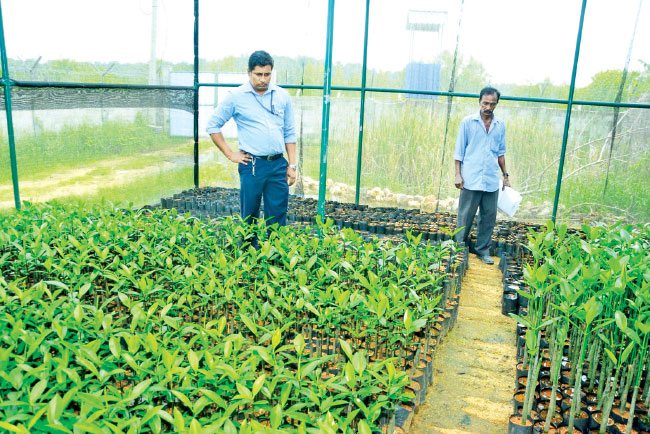
The Tokyo Cement Mangrove Conservation Project has reached a significant milestone with the planting of 100,000 mangrove saplings along Sri Lanka’s coastline, marking a meaningful contribution on World Environment Day.
This achievement reflects the long-standing collaboration between Tokyo Cement, the Sri Lanka Navy, local fishing communities, and likeminded conservation groups.
The Tokyo Cement mangrove restoration initiative began in 2012 with the establishment of a mangrove nursery at the company’s factory premises in China Bay, Trincomalee.
Its initial objective was to restore mangrove forests in the surrounding coastal belt that had been cleared during the war. Guided by conservation experts, the first phase focused on a 20-acre site adjoining the Tokyo Eastern Cement Factory, where over 17,000 saplings were planted with the participation of factory staff, the Navy, and local fishing community.
Over the years, the project has gradually expanded its reach and impact along Sri Lanka’s northeastern coastline. Today, the nursery produces approximately 7,500 saplings annually across eight native species. The Sri Lanka Navy has remained a key partner, helping extend restoration efforts to the eastern, northern, and northwestern coastal regions.
Mangrove ecosystems play a vital role in coastal livelihoods supporting fisheries, tourism, and biodiversity. They play a critical role in climate resilience by protecting shorelines from erosion, storm surges, and flooding. However, these ecosystems face increasing threats from development pressures and illegal encroachment, making their conservation an important environmental priority for island nations like Sri Lanka.
Tokyo Cement Group Corporate Manager – Sustainability Salinda Kandapola said that raising awareness about the ecological importance of mangroves is essential to sustaining restoration efforts. He added that the planting of over 100,000 mangroves represents a significant contribution toward protecting Sri Lanka’s coastline, biodiversity, and climate resilience.
Mangroves are unique ecosystems that thrive in intertidal zones where freshwater and seawater mix. Their extensive root systems stabilize coastlines by trapping sediments and reducing the impact of waves, while creating habitats for a wide variety of plant and animal species.
The protective value of mangroves has been demonstrated in areas affected by tsunamis, coastal erosion, and flooding, where healthy mangrove belts have helped reduce damage to communities and infrastructure. Mangrove forests also act as natural windbreaks and contribute to regulating local environmental conditions.
Source: Daily News